
Cognitive knowledge is self-knowledge

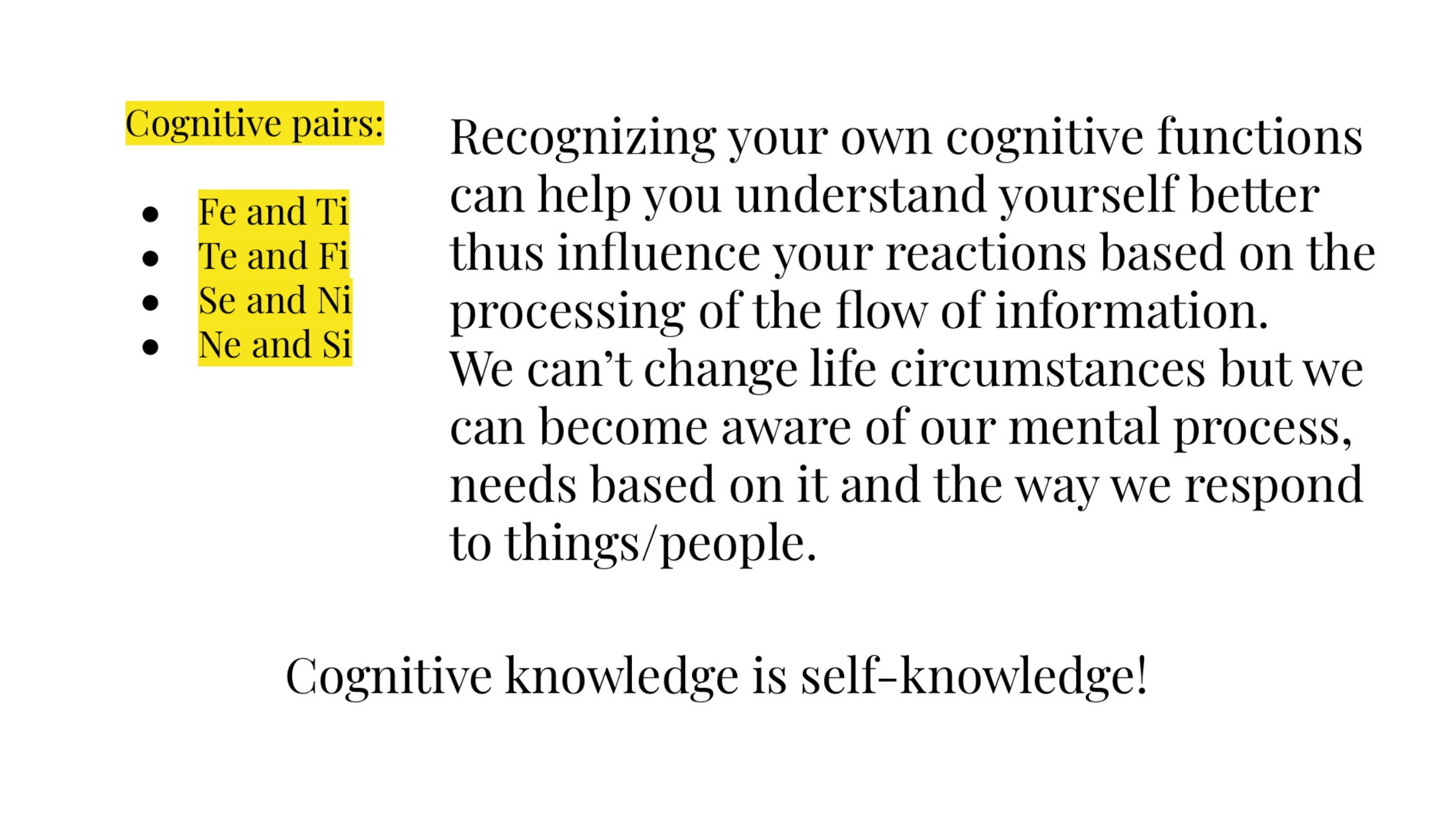
In the previous article, I have explained the meaning behind cognitive functions. Simply put, it is how our mind processes information in our daily life. The question that has perplexed many scientists is: How can we know for sure the cognitive process that different people use? How can we decode the mind?
Perhaps we could answer this question by reversing the direction. Rather than thinking how to decode the mind, we could focus on decoding information. The natural reaction to this would be that information in universal. Yes. And no. Information just is. Our mind capacity of input and output is not. We may react to underlying tones we add to information. Let’s take books as an example. Have you noticed that different people have different reactions to books? Depending on upbringing and the natural cognitive process we use, our reaction to a simple object such as a book and the content inside one will vary undeniably. I will go further into explaining such differences in the articles to come that will focus on the element of nurture in addition to nature. What I was aiming to illustrate here was the fact that our minds make connection to things that are learned and therefore conditioned. Knowing how our mind works and understanding the why, how and what of it, helps us become self-aware and mindful. We start embracing growth mindset instead of a fixed one. This is where the findings in psychology can play a crucial role.
Now, let’s go back to the decision making and perceiving functions. What do they do? What sort of information they consider? One way or another, you might have come across articles, posts, tests, and different content that talks about personality types, MBTI, Myers-Briggs,… The first reaction might have been suspicion. Can a test tell you your personality type? And what it the connection between that and cognitive process? As I have been studying cognitive functions and personality types, I have gone through a series of experiments in order to understand the material at hand. So, I have tested the tests. Unfortunately, there isn’t any test out there that is accurate. Rather than relying on a test result as an indicator of one’s cognitive process, the best way to identify the cognitive functions one relies on is through understanding all of them, what they do and how they may come across.
Let’s break the complex information that aims to decode the functioning of the mind into simple terms in order to understand it accurately.
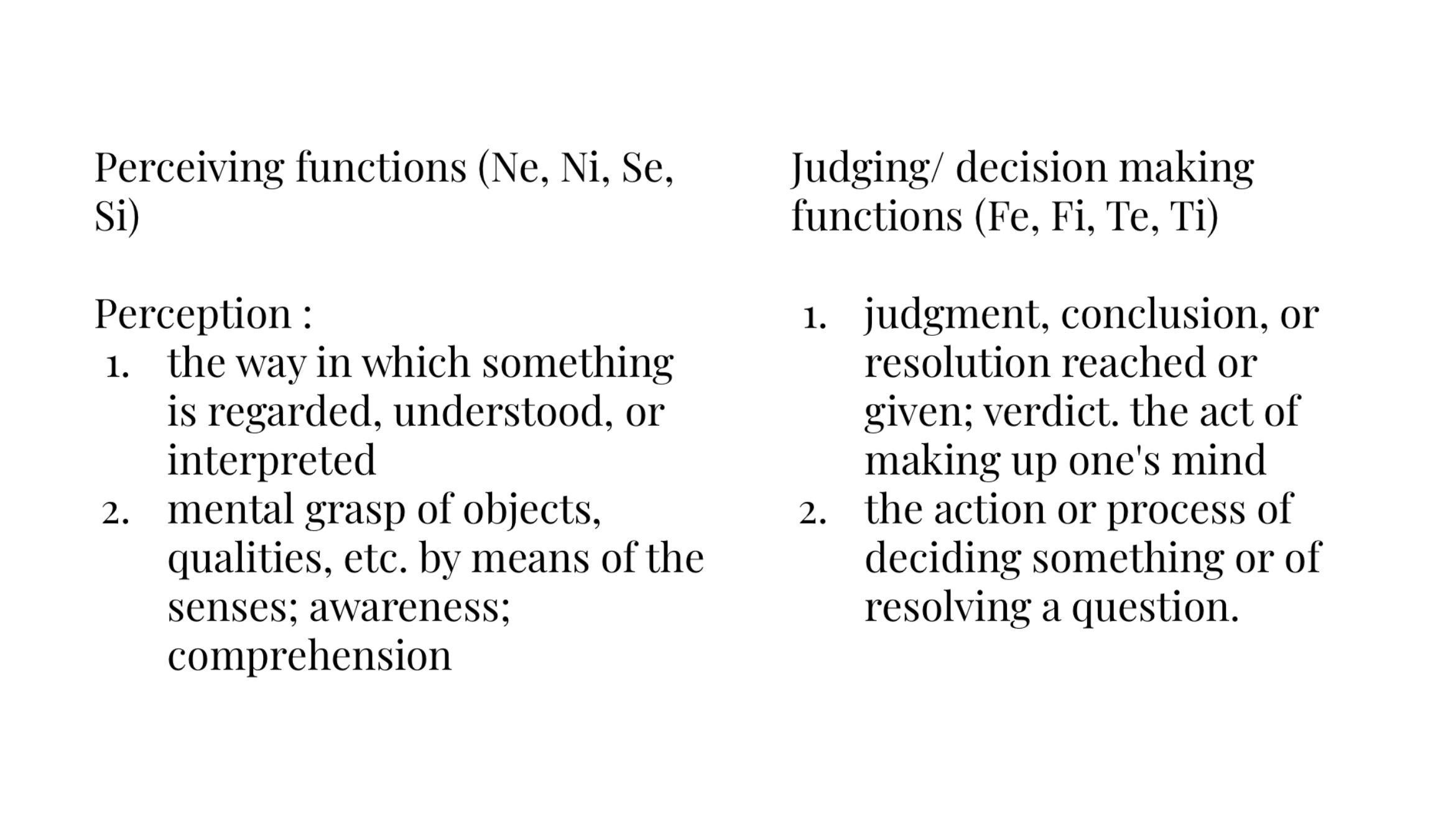
Perceiving functions (Ne, Ni, Se, Si)
Ne - Extraverted Intuition
Ni - Introverted Intuition
Se - Extraverted Sensing
Si - Introverted Sensing
Perception :
the way in which something is regarded, understood, or interpreted
mental grasp of objects, qualities, etc. by means of the senses; awareness; comprehension
Judging/ decision making functions (Fe, Fi, Te, Ti)
Fe - Extraverted Feeling
Fi - Introverted Feeling
Te - Extraverted Thinking
Ti - Introverted Thinking
judgment, conclusion, or resolution reached or given; verdict. the act of making up one's mind
the action or process of deciding something or of resolving a question.
In the articles to come, I will be dissecting each cognitive function separately so we can take a closer look of what is hidden behind the abbreviations mentioned above.